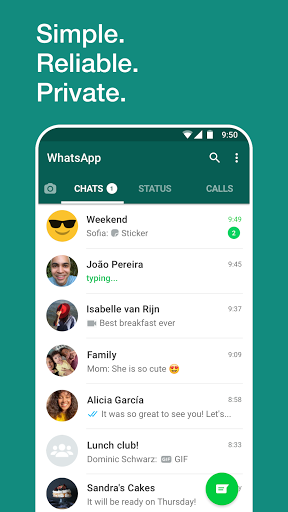
WhatsApp Messenger helps high-intent users communicate securely, including business teams looking for reliable customer support, international reach, and low-friction onboarding.
End-to-end encryption supports privacy-focused messaging, which is attractive to regulated industries and fintech or healthcare organizations seeking trust and compliance alignment.
Because WhatsApp works across mobile and desktop on slow connections, it can support subscription services, recurring updates, and time-sensitive notifications with minimal drop-off.
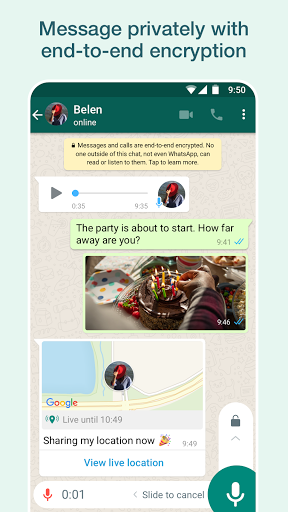
1) Private messaging across the world: personal chats and calls are end-to-end encrypted, so only participants can read or listen.
2) Simple and secure connections: use your phone number, skip user names and complex logins, and start messaging quickly.
3) High quality voice and video calls: make secure calls for up to 32 people for free, using your internet service even on weaker networks.
4) Group chats to stay in contact: encrypted group chats enable sharing messages, photos, videos, and documents across mobile and desktop.
5) Real time sharing: share your location with chosen chat members and stop anytime, or send voice messages for fast connection.
6) Status for daily moments: share text, photos, video, and GIF updates that disappear after 24 hours, with audience controls for contacts.
For advertisers and software companies, this feature set supports engagement loops, referral coordination, and community-building without the friction of traditional enterprise channels.
WhatsApp on Wear OS lets users continue conversations from a watch, which is useful for field teams, logistics updates, and mobile-first workflows.
Many people prefer WhatsApp Messenger because it delivers privacy, simplicity, and consistent performance, which are key traits for high-value customer communication.
For SaaS, e-commerce, and fintech brands, WhatsApp’s global reach and low setup effort can improve conversion and reduce support costs compared with more complex messengers.
1) Free messaging and video calling: no subscription fees make it easier for individuals and businesses to scale communication without recurring licensing costs.
2) Works across devices and networks: the app supports mobile and desktop use and remains usable on slow connections, reducing missed contacts.
3) Phone-number based access: using a phone number makes account creation faster, supporting onboarding for subscriptions, appointments, and recurring reminders.
4) Encrypted group communication: groups enable efficient coordination for families and also for teams that need shared context and secure exchanges.
These strengths make WhatsApp comparable to other apps while still appealing to advertisers targeting finance, payments, and customer success audiences.
WhatsApp focuses on privacy through end-to-end encryption for messages and calls, meaning content stays readable only for chat participants.
This design helps reduce exposure risk, which is particularly relevant for enterprise messaging, regulated workflows, and safety-conscious users.
WhatsApp also supports secure authentication practices by verifying phone numbers in some regions, which can help protect against unauthorized access and certain transaction attempts.
For users sending documents, photos, or voice notes, encrypted group chats aim to keep shared materials accessible only to the intended group.
While no system is perfect, WhatsApp’s approach makes it a strong option for private communication when compared with less secure alternatives.
When using any mobile network, data charges may apply, so understanding your carrier plan helps avoid unexpected costs during high-volume calling or media sharing.
1) Is WhatsApp Messenger free to use?
Messaging and calls are free, but data charges may apply depending on your mobile plan or Wi‑Fi usage.
2) Do I need a username to start?
No. WhatsApp uses your phone number, so you can connect quickly and view contacts who already use WhatsApp.
3) Are my messages and calls private?
Yes. Chats and calls are end-to-end encrypted, so only people in your conversation can access the content.
4) Can I make group voice or video calls?
Yes. WhatsApp supports group calls with up to 32 people for free, working across mobile devices using your internet connection.
5) How do I control my location sharing?
You can share your location only with individuals or groups in your chats, and you can stop sharing at any time.
If you have feedback or questions, you can contact support inside WhatsApp via Settings, then Help, then Contact Us.
For policies and deeper details, review the Terms of Service, privacy information, and safety guidance provided on WhatsApp’s official pages.